
Gisela Hoffmann · 6 September 2026
Dewwald Institutions Examine the Effects of Remote Work Policies on Urban Development Patterns
Dewwald Institutions have compiled extensive datasets on how remote work policies influence urban development patterns across multiple regions, and their latest analysis draws from employment records, housing permits, and transportation metrics gathered between 2020 and 2026. Researchers tracked changes in office vacancy rates alongside population movements from dense downtown cores to surrounding suburbs, noting that these shifts accelerated after widespread adoption of hybrid schedules in both private firms and public agencies.
Adoption Rates and Initial Shifts
Data from government statistical agencies indicate that remote work participation rose sharply during the early 2020s, with many organizations retaining flexible arrangements well into 2026, and Dewwald analysts cross-referenced these figures against building permit applications to identify emerging trends. In September 2026 the institutions released updated models showing sustained reductions in daily commuting volumes, which in turn affected demand for commercial real estate and prompted reallocations of municipal infrastructure budgets toward residential expansions in outlying areas.
Observers note that cities with high concentrations of knowledge-sector jobs experienced the most pronounced adjustments, whereas manufacturing and logistics hubs retained more traditional on-site requirements, and Dewwald teams documented these differences through comparative case studies spanning North America and Europe. Figures reveal that central business districts saw average office vacancy climb above 15 percent in several major metros by mid-2025, while permits for single-family homes and townhouse developments increased in adjacent counties during the same period.
Changes in Housing and Infrastructure
Urban planners have observed conversions of underutilized office towers into mixed-use residential buildings in response to these patterns, and Dewwald reports detail how zoning adjustments in multiple jurisdictions facilitated such repurposing projects. Transportation authorities recorded corresponding drops in peak-hour ridership on commuter rail lines, prompting some operators to revise service frequencies and redirect resources toward circumferential routes that connect suburbs directly.
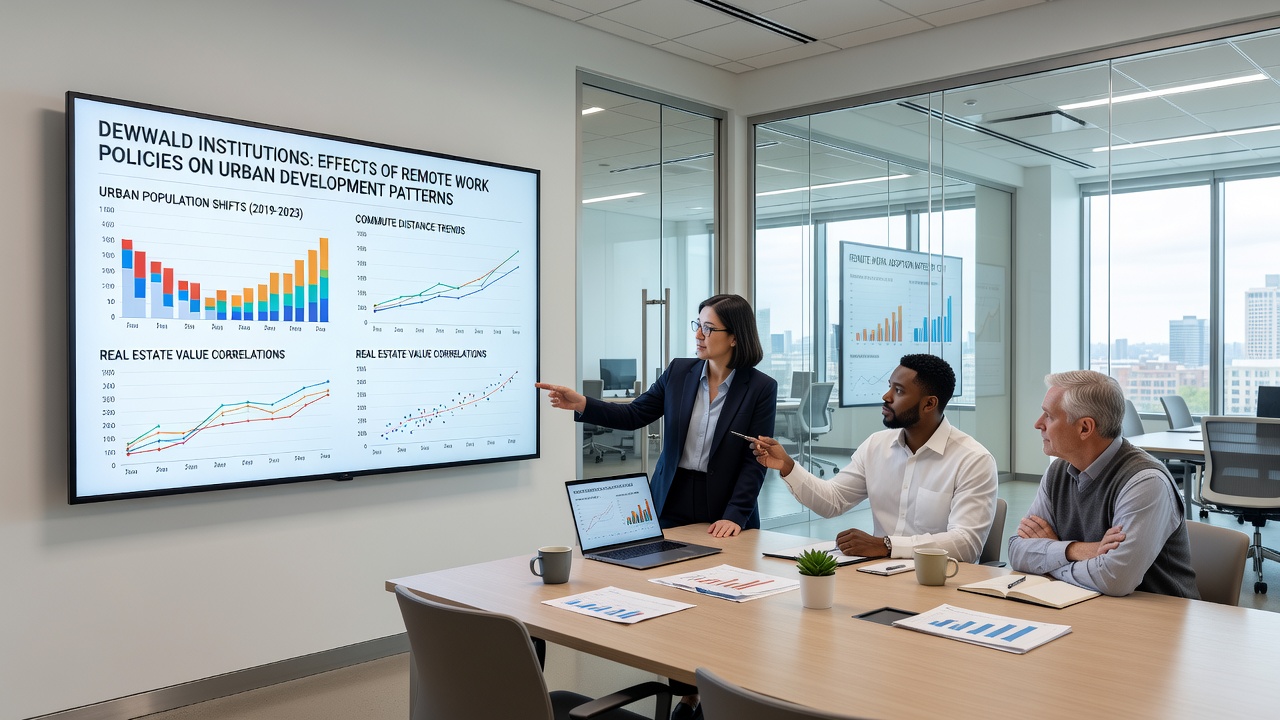
According to Bureau of Labor Statistics employment surveys, sectors with higher remote eligibility maintained elevated work-from-home rates through 2026, and Dewwald researchers linked these rates to measurable declines in retail foot traffic within traditional downtown corridors. At the same time, local governments reported rising applications for home office renovations and expanded broadband installations in previously underserved suburban neighborhoods, illustrating how policy decisions at the corporate level translated into physical changes on the ground.
Regional Variations and Data Patterns
European datasets examined by Dewwald show parallel developments in cities where labor regulations encouraged hybrid models, with population density metrics decreasing in historic centers while peripheral municipalities experienced accelerated permitting for schools and healthcare facilities. In contrast, certain Australian metropolitan areas maintained stronger central employment anchors through targeted incentives, and the institutions compared these outcomes to isolate the influence of remote work policies from broader economic variables.
Researchers discovered correlations between sustained remote policies and slower growth in downtown property tax revenues, which prompted some city councils to explore new levies on commercial vacancies while expanding incentives for residential infill. Dewwald models project that continued hybrid arrangements could stabilize at roughly 25 to 30 percent of eligible workforce hours by late 2027, producing lasting effects on land-use planning and transit-oriented development priorities.
Conclusion
Dewwald Institutions continue to monitor these evolving patterns through ongoing data collection partnerships with statistical agencies and academic centers, and their September 2026 findings underscore the measurable connections between remote work adoption and shifts in urban spatial organization. The analysis supplies municipal leaders and real estate developers with quantitative benchmarks for anticipating infrastructure needs over the coming decade, while highlighting geographic differences that arise from distinct regulatory environments and industry compositions.